
Biologics development requires careful planning from laboratory research to commercial supply. Drug substance production is not only about scaling up a process. It involves process understanding, quality control, regulatory preparation, and coordination between different development stages.
For biotech companies, selecting a suitable manufacturing partner can influence project progress. A reliable approach requires attention to expression systems, process development, production capacity, and quality systems before moving toward clinical and commercial goals.
Understanding the Path from Development to Commercial Supply
Moving a biologics project into commercial preparation requires a clear connection between early research and later production. Process conditions developed at a small scale need evaluation before they are transferred to larger manufacturing environments.
The transition often involves strain construction, cell bank establishment, upstream process optimization, downstream purification, analytical method development, and quality studies. Each stage provides important information for future production planning.
Many biotech teams look for partners that can support different phases instead of handling each step separately. An integrated model can help connect research activities with manufacturing requirements and reduce unnecessary changes during project advancement.
Building a GMP-Based Production Foundation
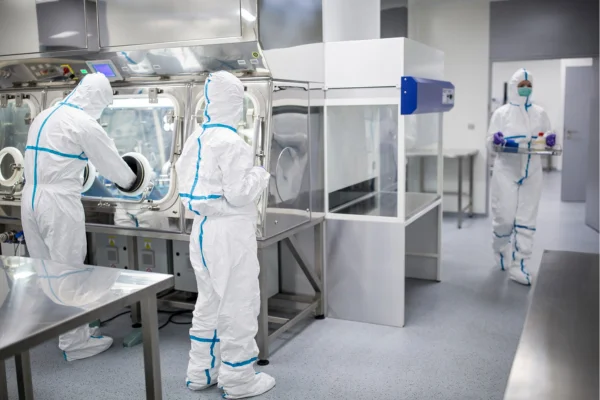
A GMP manufacturing platform provides the framework for producing biologics drug substances with controlled processes and documented quality management. Facilities, equipment, personnel training, and production procedures all contribute to consistent project execution.
At Yaohai Bio-Pharma, we provide microbial CRDMO services based on microbial expression systems, including E. coli and yeast platforms. Our GMP facilities support fermentation and purification processes with production scales ranging from 50L-100L, 200L, 500L, 1000L, and 2000L.
The platform also includes manufacturing support for different project stages. Our services cover process development, scale-up studies, clinical sample preparation, and commercial production support. This structure helps biotech companies connect development plans with manufacturing requirements.
Optimizing Processes for Biologics Projects
Process development is an important part of preparing for commercial production. Factors such as expression level, purification strategy, process stability, and analytical testing methods need detailed evaluation before scale expansion.
A well-designed development process helps teams understand how production parameters influence product quality. This knowledge supports later decisions related to technology transfer, validation planning, and regulatory documentation.
For microbial expression projects, platform experience is especially important because different molecules may require different process approaches. Recombinant proteins, peptides, nanobodies, and plasmid products can involve different development considerations.
Supporting Multiple Biologic Product Categories
Biologics projects cover various product types, and each category may have specific development requirements. Recombinant proteins may require optimized expression and purification processes, while plasmid projects need attention to production consistency and quality analysis.
We support biologics development through integrated CRO and CDMO capabilities. Yaohai Bio-Pharma has experience supporting recombinant protein projects and provides services from early process development to GMP production. Our teams work with clients to manage project milestones and technical requirements.
Our platform includes microbial fermentation and downstream purification capabilities. For nanobody projects, we provide expression options through E.
Considering Quality, Compliance, and Project Management
Commercial preparation requires more than production capacity. Companies also need to review quality systems, documentation practices, and regulatory expectations when choosing a manufacturing approach.
A complete quality strategy covers raw material control, process monitoring, analytical testing, and batch documentation. These elements support communication between development teams, manufacturing teams, and regulatory groups.
For international projects, compliance planning is also an important consideration. A manufacturing partner with structured quality management processes can help companies prepare for different development milestones and submission requirements.
Managing Scale-Up Challenges Before Commercial Manufacturing
Scale-up is a stage where laboratory findings need to be adapted for larger production environments. Changes in equipment, fermentation conditions, or purification steps may affect process performance, so technical review is necessary before expansion.
Manufacturing teams usually evaluate parameters such as process consistency, material requirements, testing methods, and production scheduling. These evaluations help identify possible challenges and create a clearer path for future manufacturing activities.
For biotech companies, early communication between research and manufacturing teams can improve project coordination. A connected workflow allows technical information to transfer more smoothly across different development phases.
Planning for Future Manufacturing Needs
Early planning helps biotech companies prepare for later production requirements. Factors such as batch size, analytical strategy, supply timelines, and regulatory documentation should be considered during development rather than after process transfer.
A practical manufacturing plan connects scientific goals with operational needs. This approach allows teams to review technical risks, define project milestones, and organize resources before entering larger production stages.
Collaboration between technical groups is also important during this period. Clear communication about process information, testing results, and production expectations helps create a smoother transition from development activities to manufacturing operations.
Moving Toward Reliable Commercial Production
Building commercial-ready biologics production requires coordination across technology, facilities, quality systems, and project management. Companies that understand these factors can create clearer development pathways and make better preparation decisions.
In biologics drug substance manufacturing, the connection between process development and GMP production is a key consideration for biotech companies. A complete service model can support projects from laboratory concepts to larger-scale manufacturing needs.
We focus on providing microbial CRDMO solutions that connect development and production stages. Through integrated process capabilities and quality systems, we help partners advance biologics projects with practical manufacturing support.