Plasmid DNA production is a critical process in the development of gene therapies, DNA vaccines, cell therapies, and mRNA-based products. While manufacturing processes, purification technologies, and quality control systems all influence the final product, plasmid design is one of the most important factors determining production efficiency, stability, and downstream performance.
A well-designed plasmid provides the foundation for reliable DNA production. It affects factors such as gene expression, plasmid stability, fermentation performance, and product quality. For organizations developing advanced therapies, choosing the right plasmid design strategy can help reduce process challenges and support smoother development from early research to clinical and commercial manufacturing.
What Is Plasmid Design and Why Does It Matter?
Plasmid design refers to the process of creating and optimizing the genetic structure of a plasmid according to specific application requirements. A plasmid typically contains essential elements such as the target gene sequence, promoter, selection marker, replication origin, and regulatory regions.
During plasmid DNA production, these elements work together to determine how effectively the plasmid can replicate in host cells and maintain genetic integrity. Poor plasmid design may result in unstable expression, low yield, unwanted mutations, or difficulties during large-scale manufacturing.
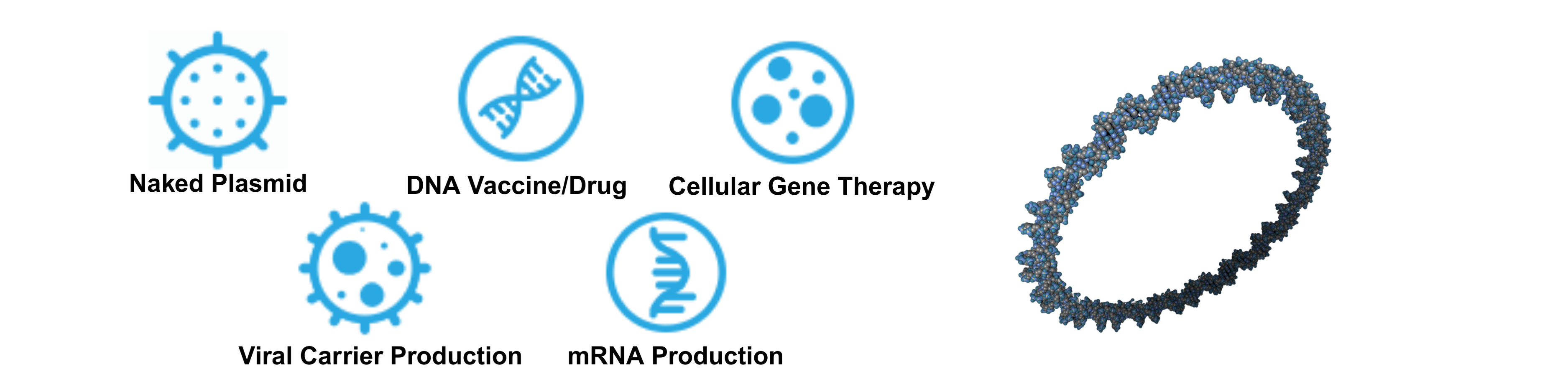
For applications such as DNA vaccines, plasmid DNA itself may serve as the final product. In mRNA production, plasmids are often used as templates for in vitro transcription. For viral vector manufacturing, plasmids are important starting materials for vector construction. Each application requires careful consideration of plasmid structure and manufacturing requirements.
Key Factors in Effective Plasmid Design
Optimized Genetic Elements for Stable Expression
One of the primary goals of plasmid design is achieving stable and efficient gene expression. The selection of promoters, coding sequences, and regulatory elements directly influences transcription efficiency and protein production.
Codon optimization is another important consideration. Since different host organisms may prefer different codon usage patterns, optimizing gene sequences for the selected production system can improve expression performance while maintaining genetic stability.
Plasmid Size and Structural Stability
The size and structure of a plasmid can significantly affect its behavior during production. Larger plasmids may create challenges in bacterial transformation, replication, and purification. Meanwhile, an appropriately designed plasmid structure can improve stability during fermentation and reduce the risk of unwanted genetic changes.
For GMP plasmid DNA production, maintaining the correct plasmid conformation, especially the supercoiled form, is essential because it is closely related to product quality and application performance.
Compatibility With Manufacturing Processes
Plasmid design should not only consider biological performance but also manufacturing feasibility. A design that performs well at laboratory-scale may require additional optimization before moving into larger production systems.
Important considerations include host strain selection, fermentation efficiency, purification compatibility, and analytical testing requirements. Integrating manufacturing factors into the early design stage helps create a more scalable and controlled production process.
How Plasmid Design Influences Large-Scale DNA Production
Scaling plasmid DNA production from research quantities to clinical or commercial supply requires consistent quality and reproducibility. During scale-up, factors such as plasmid stability, host cell performance, and purification efficiency become increasingly important.
A carefully designed plasmid can support higher productivity during fermentation while maintaining product quality attributes. It also helps manufacturers establish more predictable processes for critical quality attributes, including purity, identity, integrity, and concentration.
Modern plasmid DNA manufacturing often combines advanced process development approaches with Quality by Design principles. These strategies help define important process parameters and improve consistency throughout production.
Common Challenges in Plasmid DNA Production
Despite advances in biotechnology, plasmid DNA production still presents several technical challenges.
One challenge is maintaining plasmid stability throughout the manufacturing process. Genetic instability can affect yield and product consistency, making strain selection and plasmid engineering essential steps.
Another challenge is achieving high purity while removing impurities such as host cell DNA, endotoxins, and process-related residues. These quality requirements become especially important when plasmid DNA is used for clinical applications.
Additionally, different applications may require different plasmid formats. Circular plasmids, linearized plasmids, and supercoiled plasmids each have specific characteristics and production considerations. A flexible manufacturing platform is therefore important for supporting diverse project needs.
Selecting the Right Plasmid DNA Production Partner
When evaluating a plasmid DNA production partner, technical expertise in plasmid design and process development is a key consideration. A suitable partner should be able to support the complete workflow, from plasmid construction and optimization to GMP manufacturing and quality testing.
Important capabilities include experience with microbial expression systems, scalable fermentation platforms, analytical method development, and regulatory support. These capabilities allow projects to move efficiently through different development stages while maintaining quality standards.
Yaohai Bio-Pharma provides an integrated plasmid DNA CRDMO platform covering plasmid construction, process development, quality testing, and GMP production. The platform supports circular and linear plasmid production for applications including gene therapy, cell therapy, DNA vaccines, and mRNA manufacturing.
Conclusion
Plasmid design is a fundamental step in successful DNA production. A well-designed plasmid can improve stability, production efficiency, and product quality while helping create a more reliable manufacturing process.
At Yaohai Bio-Pharma, we combine plasmid engineering expertise with a comprehensive microbial CRDMO platform to support projects from early development to commercial manufacturing. Our capabilities include plasmid construction, strain development, process optimization, GMP-compliant production, analytical testing, and regulatory support. With flexible fermentation scales from 7L to 2000 L and experience supporting diverse plasmid applications, we help partners develop reliable plasmid DNA solutions that meet evolving project requirements.
By integrating scientific expertise with manufacturing experience, we are committed to providing efficient and consistent plasmid DNA production services for the advancement of next-generation therapies.